Sunday, February 27, 2011

Snow-Gardening

Hey, it's too early for daffodils and too late for Christmas lights. What can you do to fill the seasonal gap in your home landscape?
How about some ephemeral but uplifting Snow-Gardening? Sure, it will be gone tomorrow (this is Vancouver after all) but in the meantime, let our on-call staff of professional and discrete snow-gardeners transform your winterscape.
Seize the Snow-Day! Call us 12 hours ago. (Too late for 2011, but keep us in mind for next year!!)
Products include:
Candle-lit Snowball Igloos (small, medium, and large).


Floral-Themed Snowmen or Snowladies*.
*Snowladies cost extra.
[We emphasize the ephemeral nature of our products. Our "Rosie" prototype (pictured above with discrete Snow-Gardening staff) did a face-plant approx. 5 hours later due to a sudden warming trend. This in no way reflects her structural integrity, or lack thereof.]

Saturday, February 26, 2011

Icicle-Gardening 2011

Glace-ial stone...


It's a bit of a novelty when the temperature drops below freezing around here, and we experience things like ice and snow. I personally keep an eye out for impromptu ice-sculptures, for which I can take no credit. Here are some more surprising and magical formations found while rock-hopping in Lynn Creek...

Bellflowers...


Ice-trumpets...
Glace-ial stone, again, on a different setting (how cool is that?!)...

Hardy Signs of Life

We're getting our cold snap now, so I've only been venturing out in the sunny gaps between snow/hail showers to prune/see "what's up" in garden land. Snowdrops are up. So are the little reticulata irises at Roswitha's...


I wonder how they've fared the last couple nights. Even the hellebores in my garden are rethinking their early start...

So were Andy and Jono (intrepid arborist and right-hand man), who started recurving this laurel hedge one frosty day, while I prepped, protected, and stuck up for the perennial beds below.
Andy's actually great (which is why I recommend him to help in my gardens whoo!), and brought a wide ramp that he braced between two ladders so that cuttings/boots didn't crush the garden beds. He says "the older I get, the more tools I need" and I say I wish everyone brought the right gear to prevent damage to plants. I agree though, that a person can spend years in gardening, performing feats of strength and endurance out of sheer joie de vivre, and not really have to consider body-and-plant-saving systems until the big 4-0, or so.
.
While I have them in the shot, ye olde apple trees have produced a lot of new growth since their restorative pruning last year. Jim & Ro have an old friend/sculptor who comes in from the Gulf Islands to prune these trees (I imagine a woman in rustic robes, with long wavy hair threaded with grey and perhaps a sickle) and who, last year, performed quite a drastic reduction, removing several large old branches. So last summer resulted in a lot of vegetative growth, and perhaps this year we'll see more flower buds and a better crop yield by next year. Learnin' from experience...

Sunday, February 20, 2011

Self-Propelled: The Next Generation

Another random sighting--this time in Coal Harbour, where Transformers come out for a jog on a Sunday afternoon.


2011 Hobbit Houses

I took these pics shortly after wiping out on ice (in slow motion, a la bicyclette) and landing in goose poo in Stanley Park today. It was worth it. I looked up...and saw these.


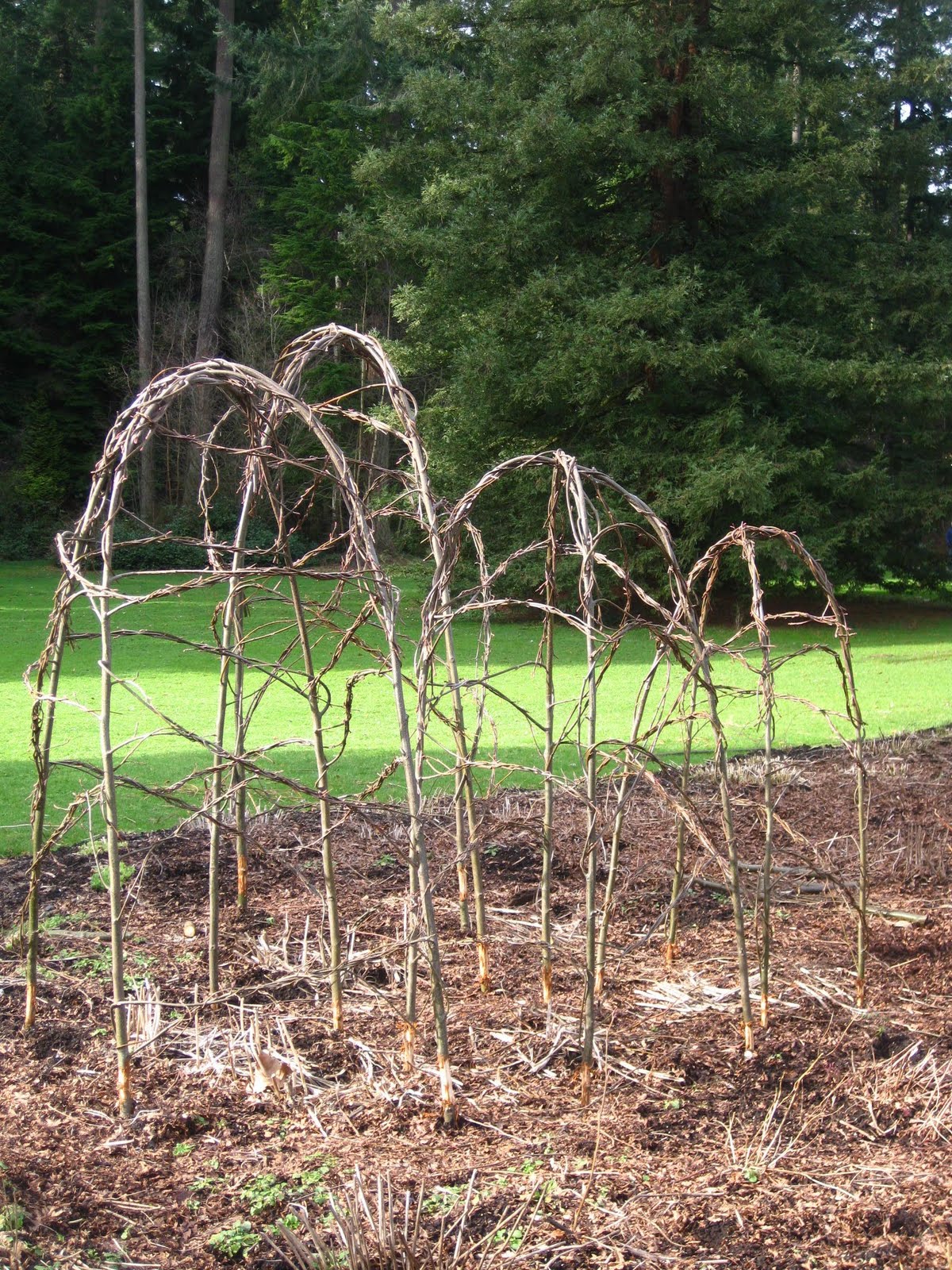
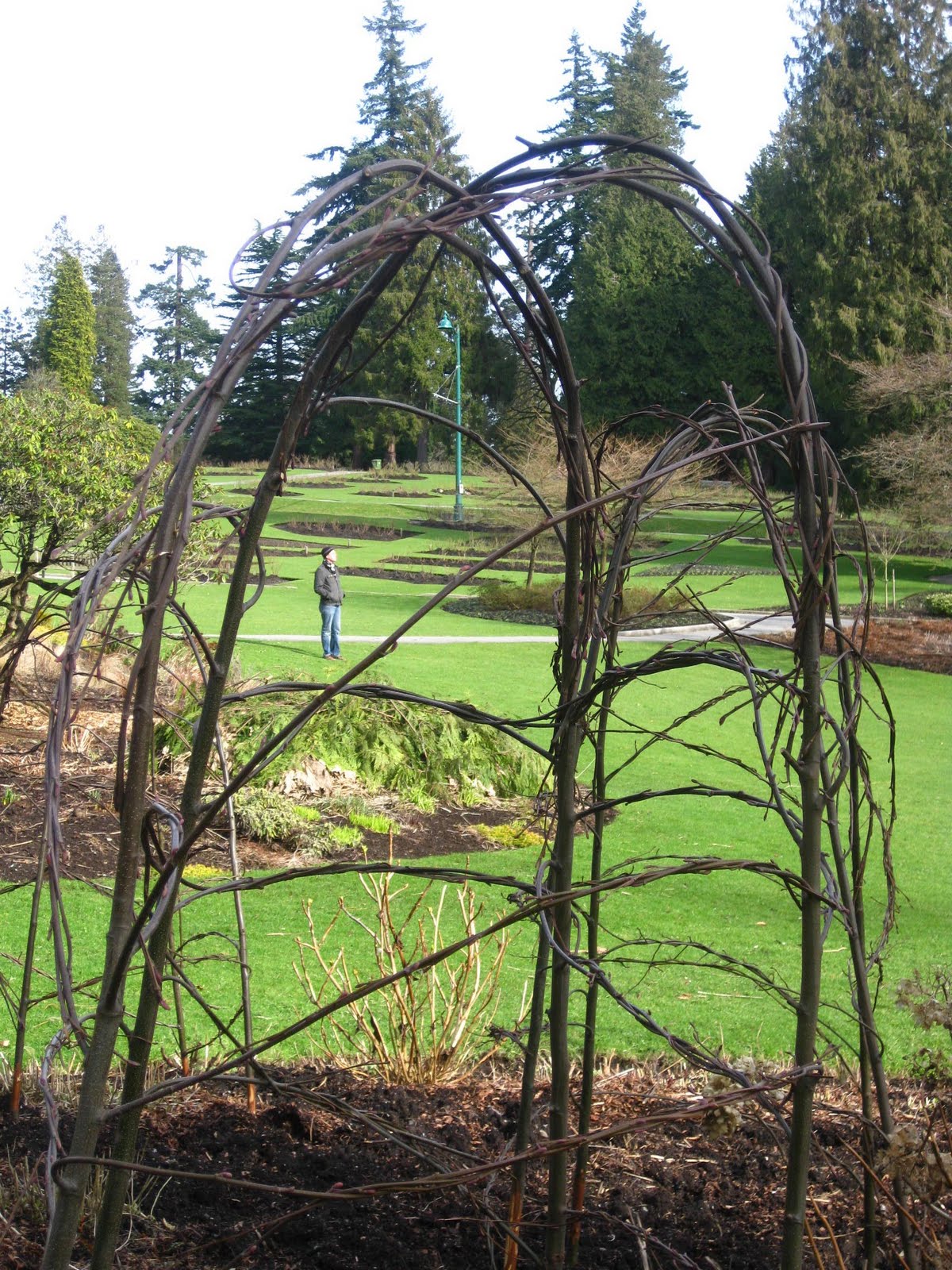
Updated from 2010 models, these are possibly the most statuesque Hobbit Houses I've seen yet. They probably have a real name--something quaint and British like "twiggeries"--but I either call them "wigwams" (neither quaint nor British) or Hobbit Houses, for reasons obvious to me. These particular houses will support large patches of tall Phlox.

This post is mainly for my own How-To benefit, for future reference. In fact, if I kept pics like this under wraps, I could probably take credit for inventing Hobbit Houses. Whenever I build them in clients' gardens, they think I'm absolutely brilliant because they've never noticed them before.

Case in point: notice the random gentleman, below, oblivious to the presence of Hobbit Houses.

FMI (For My Information): the gardeners here used entire saplings (retaining side branches instead of stripping the main trunks into poles); they bend opposing saplings into archways to form the main structure, then interwine the side branches as well, for bracing. Nice work. And you thought putting up a tent was hard.